When setting up opening balances in LocalizeBook, your business may have inventory quantities and values carried forward from your previous accounting system.
To maintain accurate inventory records, these opening balances should be linked to the appropriate Item Master Data using the Inventory Account.
This allows you to track individual inventory quantities and values while ensuring that the total inventory balance agrees with your general ledger.
This guide explains how to record opening inventory balances using Stock Adjustment, which automatically offsets the existing balance from Inventory-Old to the appropriate Inventory Account without duplicating the amount already recorded in your Trial Balance.
Step 1: Prepare Your Item Master Data
Before recording opening inventory balances, ensure that all inventory items with opening stock have been created in LocalizeBook.
You can create items individually or import multiple item records.
When creating an inventory item, ensure that the following accounts are configured correctly:
Account | Purpose |
|---|---|
Inventory Account | Records the value of inventory held by the business and receives the opening stock value through Stock Adjustment. |
Cost of Goods Sold (COGS) Account | Records the cost of inventory when items are sold. |
Income Account | Records revenue generated from selling inventory items. |
These account mappings determine how inventory-related transactions are recorded in the general ledger.
For opening inventory balances, the Inventory Account is used to record the stock value. The COGS and Income accounts are configured for subsequent sales transactions and are not affected by the opening stock adjustment.
For detailed instructions, refer to the Create Item or Import Items guide.
Important: Check item names, item codes, and all three account mappings to avoid duplicate records and incorrect accounting entries.
Step 2: Verify the Opening Inventory Balance in the Trial Balance
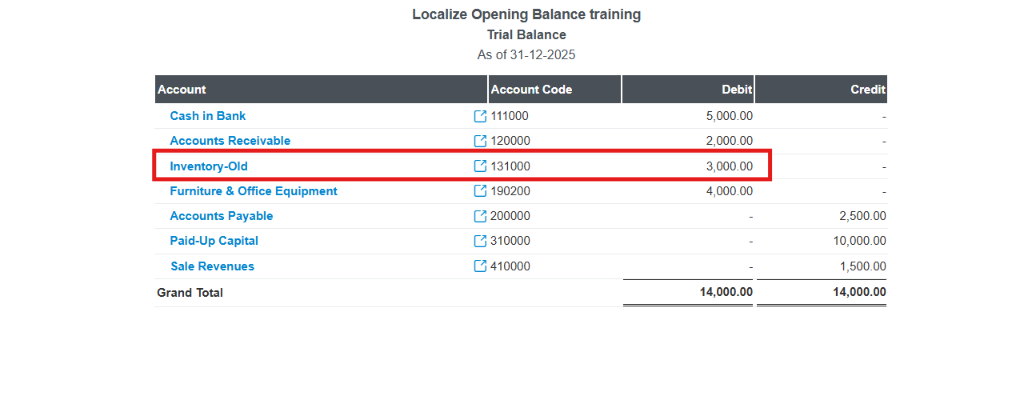
Before recording opening balances by item, verify that the total inventory balance has already been recorded in the Trial Balance under the temporary account Inventory-Old.
In this example, the Trial Balance as of 31-12-2025 shows a debit balance of 3,000.00 in Inventory-Old.
Ensure the following accounts are available in your Chart of Accounts:
Account | Purpose |
|---|---|
Inventory-Old | Temporary Other Current Asset account used to hold the opening inventory balance from your Trial Balance. |
Inventory Account | Account with the Inventory account type used to record inventory values associated with individual items. |
The Inventory-Old account should be configured as an Other Current Asset account, while the Inventory Account should use the Inventory account type.
For more information, refer to the Chart of Accounts Guide.
Step 3: Prepare Your Opening Inventory Balances by Item
Prepare a list of all inventory items with opening quantities and values as of your opening balance cutoff date.
Example:
Item | Opening Quantity | Unit Cost | Total Value |
|---|---|---|---|
Apple Juice | 100 | 30.00 | 3,000.00 |
Total | 100 | 3,000.00 |
Ensure that the total opening inventory value agrees with the Inventory-Old balance in your original Trial Balance.
Also, verify that the opening quantities and values are assigned to the correct items and warehouses.
Step 4: Record Opening Inventory Using Stock Adjustment
After preparing your Item Master Data and verifying the opening inventory balances, use Stock Adjustment to record the opening quantities and values.
LocalizeBook will automatically offset the inventory value against Inventory-Old and update the Inventory Account configured in Item Master Data.
- Go to Item → Stock Adjustment → + Add.
- Select Qty & Value in the Adjustment Type field.
- Enter the opening balance cutoff date.
- Select the appropriate Warehouse.
- In the Account field, select Inventory-Old (131000).
- Enter a Reference and Memo, if applicable.
- Select the corresponding inventory item and enter the opening quantity and inventory value.
- Review the Stock Adjustment to ensure the quantity and total asset difference are correct.
- Save the Stock Adjustment.
Example: Opening Inventory Stock Adjustment
Field | Value |
|---|---|
Adjustment Type | Qty & Value |
Date | 31-12-2025 |
Warehouse | 1.Warehouse |
Account | 131000 - Inventory-Old |
Item Name | Apple Juice |
Difference Qty | 100 |
Asset Difference | 3,000.00 |
Memo | Opening Balance 31.12.2025 |

Automatic Inventory Balance Offset
After saving the Stock Adjustment, LocalizeBook automatically:
- Updates the opening stock quantity and value for the selected inventory item.
- Records the inventory value in the Inventory Account configured in Item Master Data.
- Offsets the corresponding amount against Inventory-Old, selected in the Stock Adjustment's Account field.
For example, recording 100 units of Apple Juice with a total value of 3,000.00 automatically updates the Inventory Account and offsets 3,000.00 against Inventory-Old.
Important: No additional Journal Entry is required. LocalizeBook handles the accounting offset directly through Stock Adjustment, preventing duplicate opening inventory balances.
Step 5: Verify Your Opening Inventory Balances
After recording the opening Stock Adjustment, review the Trial Balance and Inventory Reports to ensure the balances have been recorded correctly and agree with the supporting item records.
1. Trial Balance Report
Open the Trial Balance Report and select the opening balance cutoff date.
Verify that:
- Inventory-Old has a zero balance after the full transfer.
- The Inventory Account shows a total debit balance of 3,000.00.
- The Trial Balance remains balanced, with total debits equal to total credits.
The Stock Adjustment should not change the total assets of your business. It only moves the existing opening balance from Inventory-Old to the Inventory Account.
 2. Stock Report
Open the appropriate Stock Report and select the opening balance cutoff date and warehouse.
Verify that:
- All items with opening inventory balances are included.
- Each item's opening quantity and value match the original supporting records.
- The total inventory value is 3,000.00, agreeing with the Inventory Account in the Trial Balance.
Example:
Item | Quantity | Unit Cost | Inventory Value |
|---|---|---|---|
Apple Juice | 100 | 30.00 | 3,000.00 |
Total | 100 | 3,000.00 |
 Important: The total inventory value in the Stock Report should agree with the corresponding Inventory Account balance in the Trial Balance as of the same reporting date, provided there are no other inventory transactions affecting the balances.
Important Notes
- Ensure all required Item Master Data has been created before recording opening inventory balances.
- Configure the Inventory, COGS, and Income accounts correctly when creating inventory items.
- Select the correct inventory item and warehouse when recording the Stock Adjustment.
- Use Qty & Value to record both opening inventory quantities and values.
- Select Inventory-Old as the offset account.
- Use the correct opening balance cutoff date.
- Do not record an additional Journal Entry for the same opening inventory balance.
- Avoid recording duplicate opening stock balances.
Completion Checklist
- All inventory items with opening balances have been created.
- Inventory, COGS, and Income accounts have been configured correctly in Item Master Data.
- Inventory-Old is configured as Other Current Asset, and the Inventory Account uses the Inventory account type.
- Opening quantities and values have been assigned to the correct items and warehouses.
- Stock Adjustments have been recorded using Qty & Value.
- Inventory-Old has a zero balance after the transfer.
- The Inventory Account agrees with the total opening inventory value.
- The Trial Balance and Inventory Report have been reviewed and verified.
Once all balances have been verified, your Opening Inventory Balance by Item setup is complete.