1. Overview
Inventory management involves two important questions:
- Costing: How much does the inventory we sell or use cost?
- Lot control: Which specific group or batch of inventory do we have, and where is it stored?
FIFO Costing and Lot Control help businesses manage inventory, but they serve different purposes.
This guide explains how each method works, the differences between them, and when a business should use each method.
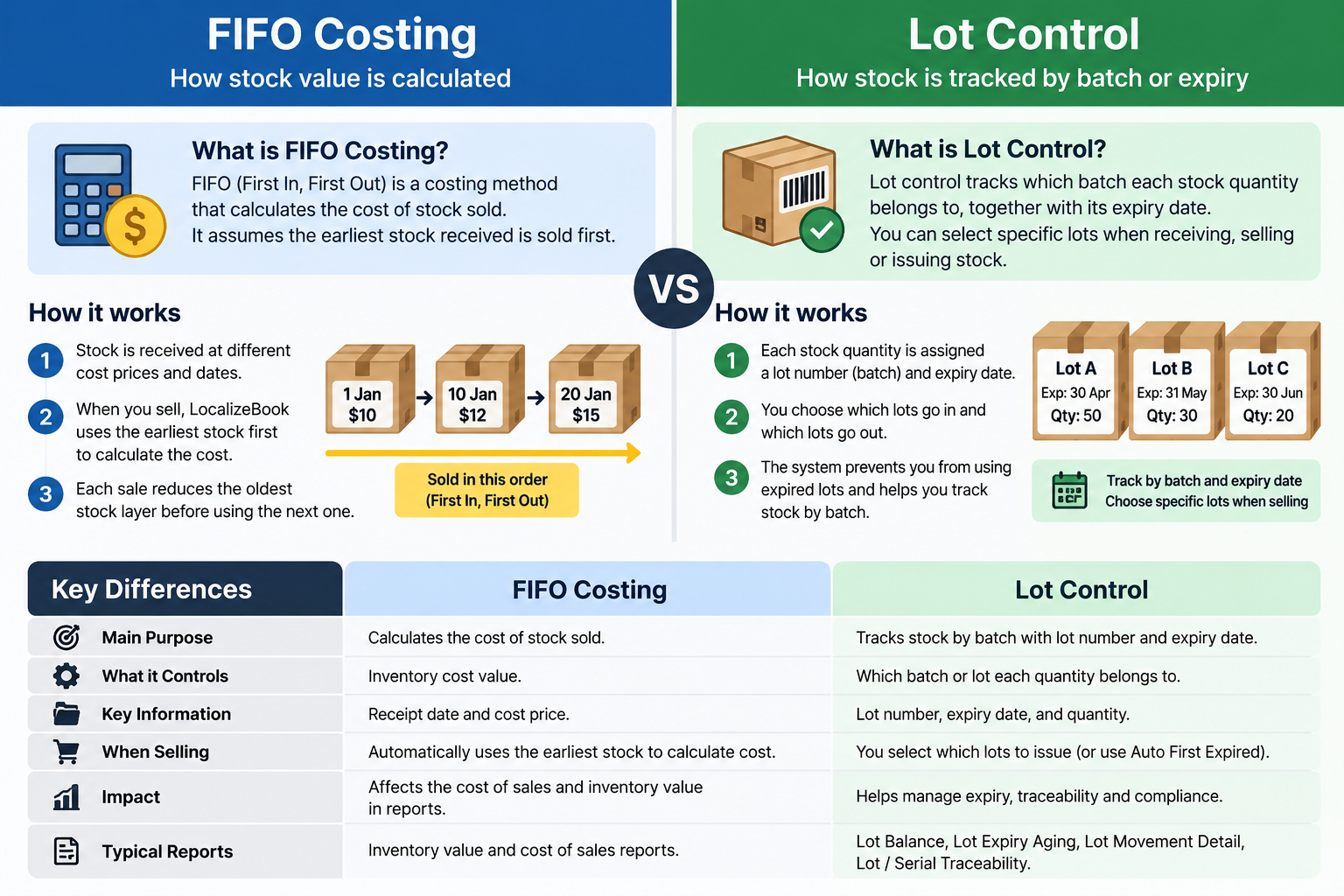
2. What Is FIFO Costing?
FIFO stands for First In, First Out. It is an inventory costing method that assumes the oldest inventory costs are assigned to goods sold or issued first.
Under FIFO, inventory is maintained in cost layers based on purchase or stock receipt transactions. When inventory is sold, the system consumes the oldest available cost layers first.
Example: Purchasing Inventory
A business purchases the same product twice:
Purchase | Quantity | Unit cost | Total cost |
|---|---|---|---|
Purchase 1 | 100 units | $10 | $1,000 |
Purchase 2 | 100 units | $12 | $1,200 |
Total | 200 units | $2,200 |
The inventory now contains two FIFO cost layers:
- Layer 1: 100 units at $10 per unit.
- Layer 2: 100 units at $12 per unit.
Example: Selling Inventory
The business sells 120 units.
Under FIFO, the system calculates the cost of goods sold (COGS) using the oldest cost layer first.
Cost calculation | Quantity | Unit cost | Total |
|---|---|---|---|
From Purchase 1 | 100 | $10 | $1,000 |
From Purchase 2 | 20 | $12 | $240 |
Total COGS | 120 | $1,240 |
After the sale, the remaining inventory is:
Remaining inventory | Quantity | Unit cost | Total |
|---|---|---|---|
Purchase 2 layer | 80 | $12 | $960 |
Total remaining | 80 | $960 |
Important: FIFO determines the cost flow for accounting purposes. It does not necessarily mean that warehouse staff must physically pick the oldest goods first.
3. What Is Lot Control?
Lot Control is an inventory tracking method that allows a business to identify and manage goods by specific batches or lots.
A lot usually represents a group of products received, manufactured, or produced together. Each lot can have its own identification number and relevant information.
Depending on the system configuration, lot information may include:
- Lot or batch number
- Supplier or source
- Receipt or manufacturing date
- Expiry date
- Quantity received
- Available quantity
- Warehouse or storage location
- Related purchase and sales transactions
Example: Managing Inventory by Lots
A business purchases 200 units of the same product from two suppliers.
Lot number | Supplier | Quantity | Unit cost |
|---|---|---|---|
LOT-A001 | Supplier A | 100 | $10 |
LOT-B001 | Supplier B | 100 | $12 |
Total | 200 |
The business can use lot control to identify which units belong to each batch.
For example, if a customer reports a quality issue with LOT-A001, the business can identify the remaining quantity in that lot and investigate which transactions involved it.
For products with expiry dates, lot control can also help staff identify batches that should be sold or used first.
Important: Lot Control does not automatically determine the accounting cost of a sale. The inventory costing method and the lot selection rules need to work together correctly.
4. FIFO Costing vs. Lot Control
Comparison | FIFO Costing | Lot Control |
|---|---|---|
Main purpose | Calculate inventory costs | Track specific batches of goods |
Primary focus | Cost layers | Physical inventory identity |
Identifies batch numbers | Not required | Yes |
Tracks expiry dates | Not by itself | Can, if supported |
Calculates COGS | Yes | Not by itself |
Tracks remaining cost by layer | Yes | Depends on the costing integration |
Supports batch traceability | Limited without lot tracking | Yes |
Helps investigate product recalls | Limited without lot tracking | Yes |
Requires FIFO costing | No additional lot tracking is required | No; it can be combined with another costing method |
The Key Difference
FIFO answers:
“What cost should be assigned to the inventory sold?”
Lot Control answers:
“Which batch of inventory was received, where is it now, and which transactions involved it?”
These functions are complementary rather than interchangeable.
5. Can FIFO Costing and Lot Control Be Used Together?
Yes. A business can use FIFO costing and Lot Control together.
Consider a business selling food products. It purchases the same product in two batches:
Lot | Receipt date | Quantity | Unit cost | Expiry date |
|---|---|---|---|---|
LOT-A001 | 1 October | 100 | $10 | 31 December |
LOT-B001 | 5 October | 100 | $12 | 31 January |
The business wants to calculate COGS using FIFO while tracking the physical inventory by lot.
The two functions work together as follows:
- Receive inventory: Record the received quantity, purchase cost, and lot information.
- Create inventory records: Maintain the relevant FIFO cost layers and lot quantities.
- Sell inventory: Record the quantity sold and the lot or lots selected for delivery.
- Calculate COGS: Apply the configured FIFO costing rules to determine the cost of the sale.
- Update inventory: Reduce the relevant inventory quantities and maintain the remaining balances.
- Review reports: Check the remaining cost layers and lot quantities for accounting and operational purposes.
An Important Design Consideration
Selecting a physical lot does not always mean that the system can simply consume the next FIFO cost layer.
For example, a warehouse may pick LOT-B001 because of a customer request, even though LOT-A001 was received earlier.
If the business requires both accurate lot tracking and FIFO accounting, the system must define how lot selection and cost-layer consumption interact. It should not silently assign an unrelated lot's cost to the goods delivered.
6. When Should You Use FIFO Costing?
FIFO Costing is useful when a business wants to:
- Calculate COGS based on the oldest available inventory costs.
- Maintain a cost history for inventory receipts.
- Calculate the value of remaining inventory.
- Understand how purchase costs affect gross profit.
- Maintain consistent inventory valuation records.
Typical examples include retailers, wholesalers, and businesses selling products with changing purchase prices.
7. When Should You Use Lot Control?
Lot Control is particularly useful when a business needs to trace inventory by batch.
Typical examples include:
- Food and beverage businesses that manage expiry dates.
- Pharmaceutical and medical supply businesses that require batch traceability.
- Manufacturers that track raw materials and production batches.
- Importers and distributors that need to identify supplier batches.
- Businesses that need to investigate defective goods or manage product recalls.
Lot Control can also help businesses manage stock rotation, provided the system supports the appropriate selection rules.
8. Common Questions
Does FIFO mean the oldest physical stock must always be sold first?
No. FIFO is an accounting costing method. A warehouse may use FIFO as its physical stock rotation policy, but the costing method alone does not enforce physical picking order.
Can I use Lot Control without FIFO?
Yes. Lot Control can be combined with other inventory costing methods, subject to the capabilities and configuration of the accounting system.
Does each lot have to have a different cost?
No. Different lots can have the same unit cost. However, the system should maintain their separate lot identities when batch traceability is required.
What happens when inventory from a lot is sold?
The available quantity of that lot should be reduced, and the sale should retain a reference to the lot or lots involved. The accounting cost should be calculated according to the configured costing method and its integration with lot selection.
What happens when a customer returns goods?
The business should record the returned quantity and identify the original sale and lot whenever possible. Under FIFO costing, the return's accounting treatment should also preserve the appropriate original cost information when the return is linked to the original sale.
Is Lot Control the same as Serial Number Tracking?
No. Lot Control tracks a group of goods under one batch identifier. Serial Number Tracking identifies individual units with unique serial numbers.
For example:
- Lot Control: 100 units share batch number LOT-A001.
- Serial Number Tracking: Each of the 100 units has its own unique serial number.
9. Summary
FIFO Costing and Lot Control solve different inventory management problems.
- FIFO Costing helps businesses calculate the cost of inventory sold and the value of remaining inventory.
- Lot Control helps businesses identify, trace, and manage specific batches of goods.
- Using both together provides inventory cost information as well as batch-level traceability, provided the system correctly connects physical lot movements with accounting cost calculations.
Choose the method that matches your business requirements. If you need both accurate financial reporting and detailed batch tracking, combining FIFO Costing with Lot Control can provide a more complete inventory management solution.